

Renting a room to a flatmate in NZ: how the tax works (and how to file it)
Renting a spare room to a flatmate is one of the most common ways New Zealanders earn a bit of extra income, or help with the mortgage — and one of the most confusing at tax time. Do you even have to declare it? What can you claim? Does your mortgage count? And how on earth do you put it in a return?
The good news: the rules are clearer than they look. For a typical owner-occupier with one or two flatmates, the maths is genuinely manageable once you've seen it done. This guide walks through it end to end — what's taxable, how to work out your deduction with IRD's floor-area method, a full worked example, and how to file. Everything here follows Inland Revenue's rules; where there's a number, I've linked the IRD page it comes from.
Is your flatmate's rent even taxable?
Start here, because not every flat arrangement creates a tax bill.
- You own the home and charge a flatmate rent → that rent is taxable rental income. But you also get to deduct a fair share of what it costs to run the house, which often brings the taxable amount right down. This is the situation this guide covers.
- You rent the home yourself and just collect your flatmates' share to pass on to the landlord → that money isn't income. IRD is explicit: if you collect rent from the others in your flat to pass on to your landlord, it's not taxable, and there's nothing to declare. (IRD: renting out a room in my main home)
- You provide meals and services, not just a room → you might have a boarder, not a flatmate, and a different (often simpler) set of rules applies. More on that next.
So if you're an owner-occupier letting a room, assume the rent is taxable — and read on, because the deductions are where it gets interesting.
Flatmate or boarder? It changes which rules apply
IRD draws a real line here, and it decides which method you use:
- Flatmates share a house, expenses and chores. You rent them a room; they look after themselves. Flatmate income is worked out using the actual cost method — your real income minus your real (apportioned) expenses. That's this article.
- Boarders and home-stay students are different: part of what they pay is for services like meals or laundry. If that's you, you can use IRD's standard cost method instead — a flat weekly figure per boarder ($245 per boarder per week for the 2025-26 year, for up to four boarders), and if your income is under your total standard costs you may not need to declare it at all. You can still choose the actual cost method if it works out better. (IRD: standard cost method for boarders)
- Short-stay / Airbnb guests are a third category again, with their own nightly standard-cost rate. Not covered here.
How to work out what you can claim: the floor-area method
Here's the core idea. Your home is partly rented and partly private, so you split your running costs by how the floor space is used. IRD's QB 23/08 (a "Question We've Been Asked") sets out three buckets:
- Space only your flatmate uses (their bedroom, where it's agreed as theirs) — 100% deductible
- Shared space everyone uses (kitchen, living room, bathroom, laundry, hallways) — 50% deductible
- Space only you use (your bedroom, your home office) — 0% deductible
The 50% for shared areas is the figure IRD accepts as reasonable — a flat half, not "proportional to who uses it more." Add the first two buckets together, divide by your total floor area, and you get the percentage of your home's running costs you can claim:
Deductible % = (flatmate-only space + half the shared space) ÷ total floor area
That percentage then applies to all your "mixed" household expenses — rates, insurance, mortgage interest, power, internet, repairs, and so on.
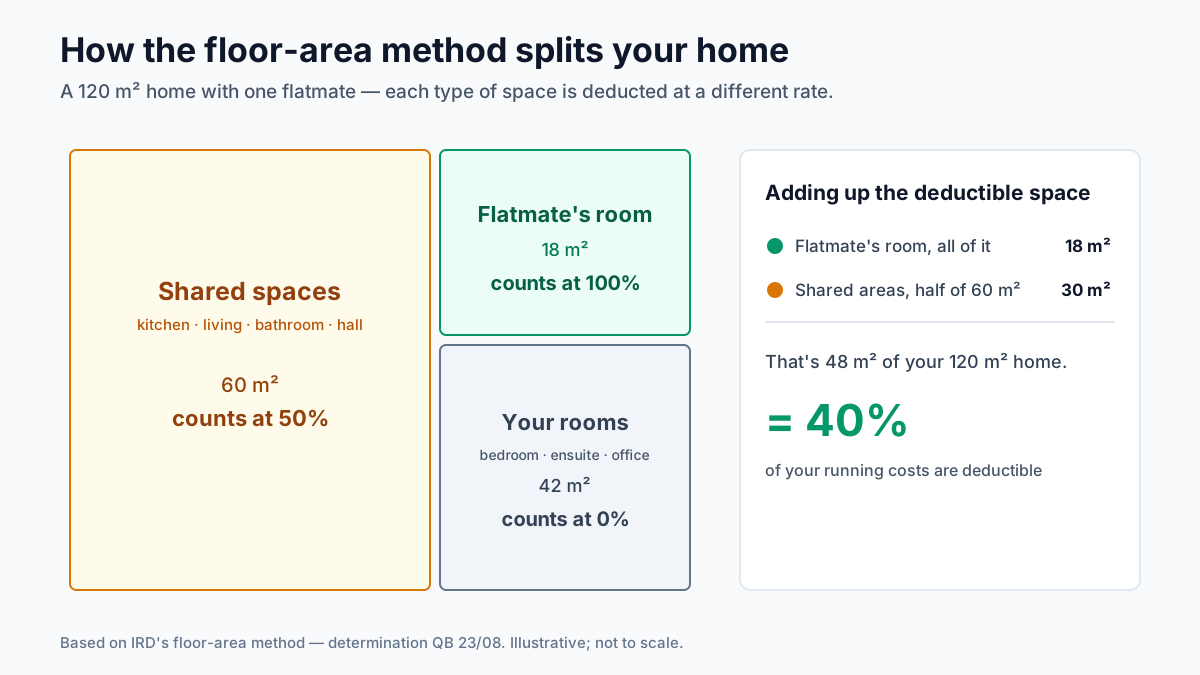
A worked example
Meet Sarah. She owns a 120 m² three-bedroom house and rents one bedroom to her flatmate Jess for $250 a week. She lives there herself and keeps the third bedroom as a home office.
Step 1 — work out the deductible percentage by floor area:
- Total floor area: 120 m²
- Jess's bedroom (her exclusive use): 18 m² → counts at 100% = 18
- Shared spaces — kitchen, living, bathroom, laundry, hall: 60 m² → counts at 50% = 30
- Sarah's own spaces — her bedroom, ensuite, home office: 42 m² → counts at 0% = 0
- Deductible portion = (18 + 30) ÷ 120 = 48 ÷ 120 = 40%
Step 2 — add up the year's running costs:
- Mortgage interest: $20,000
- Rates: $3,000
- House insurance: $2,400
- Power, gas and internet: $3,200
- Repairs and maintenance: $1,400
- Total: $30,000
Step 3 — apply the percentage:
- Deductible expenses = 40% × $30,000 = $12,000
Step 4 — work out the net rental income:
- Rent received = $250 × 52 weeks = $13,000
- Net rental income = $13,000 − $12,000 = $1,000
That $1,000 is the figure that gets taxed. It's added to Sarah's other income and taxed at her marginal rate — so if her top rate is 30%, she pays about $300 of tax on her flatmate income for the year. Compare that with the $3,900 she'd pay if she declared the full $13,000 and didn't realise she could claim her share of the household costs. Knowing the method is worth real money.
What if the room wasn't rented for the whole year?
Sarah's example assumes Jess lived there all 52 weeks, so the floor-area percentage is the whole story. If a room is only rented for part of the year, you also scale the ongoing costs by the time it was rented — IRD's rule is to divide the income-earning days by the days in the year (for example, 300 ÷ 365). (IRD: working out expenses when you live in the property)
One nuance people get wrong: a room only counts while it's rented. Days it sits empty between flatmates — even while you're advertising it — are private use, not rental (QB 23/08, paragraph 7). Counting the days a property is available but empty is a rule for whole properties rented out, not for rooms in your own home.
This day-by-day tracking is fiddly to do by hand, which is exactly the kind of thing Zelvo handles for you: it tracks each room's tenancy day by day and adjusts the ratio automatically when a room sits empty or changes hands.
Ring-fencing — and why it probably doesn't apply to you
"Ring-fencing" stops most residential landlords from using a rental loss to reduce the tax on their other income — the loss is trapped and carried forward instead. Flatmate landlords often assume this hits them. Usually it doesn't.
IRD's rules have a main-home exclusion (IRD: residential property deductions). For flatmates, IRD's QB 23/08 sets out the test: ring-fencing doesn't apply where more than 50% of the property is used as your main home for more than half the income year. For a normal owner-occupier renting out one or two rooms, that's easily met — so a rental loss can offset your salary or wages, as in Sarah's loss example above. The exception to watch: if your flatmates' exclusive space is so large that your own private-plus-shared space drops to half the home or less.
Two more deductions: chattels and vehicle costs
Depreciation on chattels. Appliances, carpet, curtains, furniture, a single-split heat pump — these wear out over time, so you can claim a slice of their value each year, apportioned by the same floor-area split (a shared dishwasher at 50%; something only your flatmate uses at 100%). Two things to know: the building itself can't be depreciated — only its chattels — and anything costing $1,000 or less (before the floor-area split) can be claimed in full the year you buy it. Zelvo tracks each chattel's depreciation year after year at IRD rates and handles the apportionment for you — give it a try, or crunch the numbers in the chattels calculator first.
Vehicle costs. Trips you make specifically for the rental — say a hardware run for materials to fix the rented room — are worked out separately from the floor-area split. You claim them using IRD's kilometre rates, based on the kilometres you drive for the rental, not the room percentages. See our guide to the 2025-26 IRD kilometre rates for how that works.
How to actually file it
This is the part most guides skip. Here's the path:
- You file an IR3 (the individual income tax return), showing your rent received and your apportioned expenses — the rental income schedule, IR3R, sets these out line by line, and the net (your rental profit or loss) carries into your return. (IRD: who pays tax on rental income)
- Declare it as other rental income, not "residential rental property." Because the room is in your main home, it sits outside the ring-fencing rules (the main-home exclusion explained above) — so it doesn't belong in the residential-rental-property section, which automatically traps losses. Entering it as other rental income is what lets a loss reduce the tax on your salary — so whether you file in myIR yourself or hand it to an accountant, make sure that's where it ends up.
- Own the home with someone else? Each co-owner files their own IR3 for their share of the income and expenses, split by ownership percentage — you don't need a separate partnership return.
- Keep your records for seven years — receipts, invoices, your floor-area working, and tenancy dates. IRD can ask for them.
- One more to know: if the total tax you owe for the year tops $5,000, you may move into provisional tax for the following year. For a small flatmate profit on top of a salary, that usually won't bite.
Common questions
Do I have to declare flatmate income?
If you own your home and charge a flatmate rent, yes — it's taxable income, though you deduct a share of your running costs against it (which often leaves only a small amount, or a loss). The exception: if you rent the place yourself and simply collect your flatmates' share to pass on to your landlord, that money isn't taxable.
How much tax will I pay on flatmate rent?
You're taxed on the net — rent received minus your apportioned expenses — at your marginal tax rate. In the example above, $1,000 of net income at a 30% rate is $300. With a larger mortgage the result can be a loss, which (because it's your main home) reduces the tax on your other income instead.
Is my flatmate actually a boarder?
Only if you provide meals or services like laundry as part of the deal — then they're a boarder, and you can use IRD's standard cost method. If you just rent them a room and they fend for themselves, they're a flatmate, and you use the actual cost method described here.
Can I claim my mortgage if I have a flatmate?
You can claim the apportioned share of the mortgage interest (never the principal repayments). The interest limitation rules that cut investors' interest claims from 2021 to 2025 never applied to your own home (QB 23/08), so you claim your floor-area percentage of the interest — in Sarah's case, 40%.
Where Zelvo fits in
This is exactly what I built Zelvo to do. Most NZ tools don't handle the owner-occupier flatmate case at all — people end up in a spreadsheet, guessing at the apportionment. Zelvo:
- Applies the floor-area method correctly — 100% for flatmate-only rooms, 50% for shared spaces — from your actual room measurements.
- Tracks each room's tenancy day by day, so a room that's empty for a month adjusts the ratio for you.
- Splits joint ownership properly, giving each owner their own IR3 figures.
- Produces the IR3R line-by-line, ready to copy into myIR.
Setup takes about 10 minutes, and your first property is free, no credit card. Add your property and see your numbers — or hand the finished report to your accountant.
— Hari